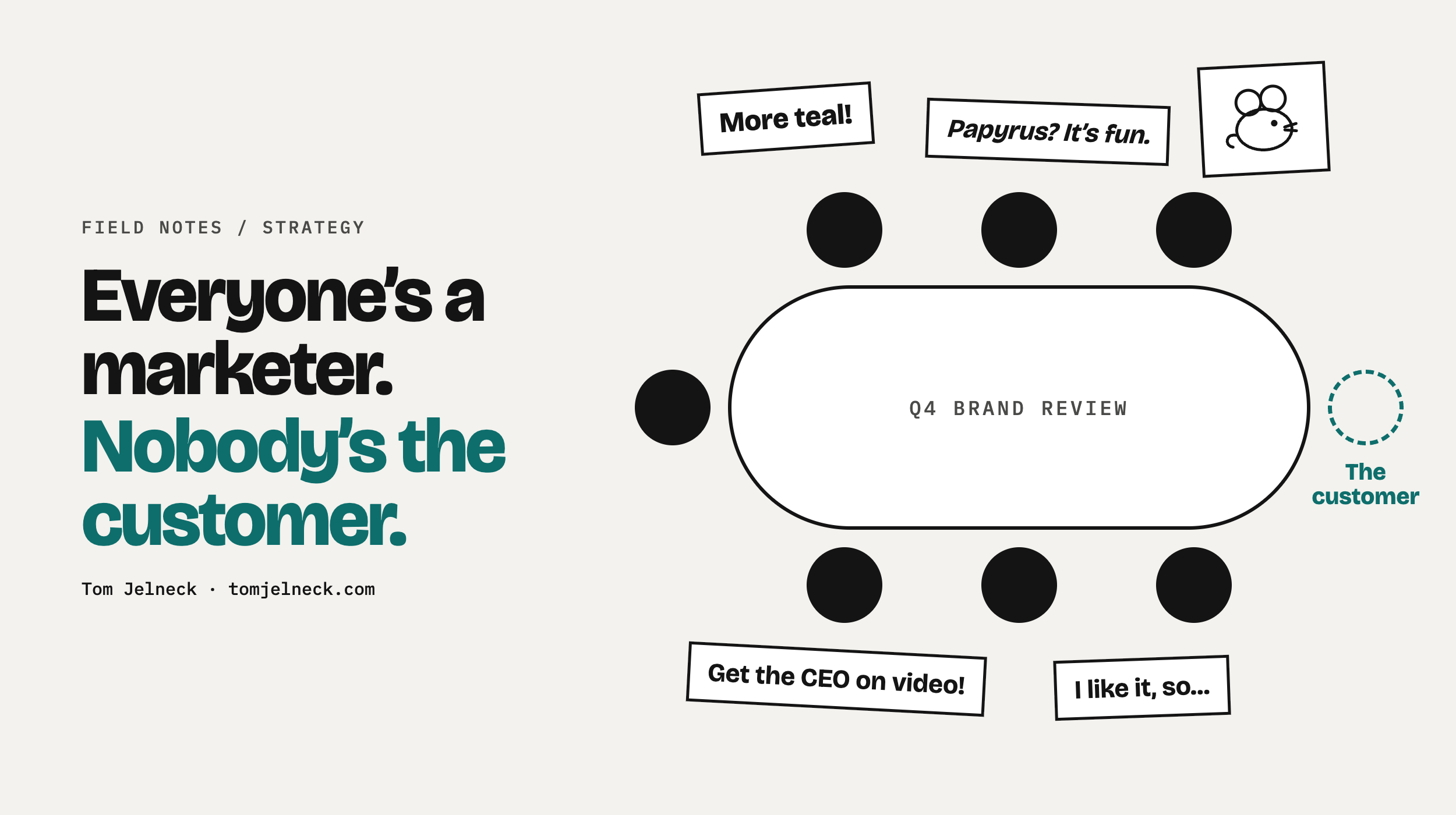
"It needs more teal."
"Let's use Papyrus. It's fun."
"Let's get the CEO to record a message telling customers how much they'll like the product, because she uses it too."
"What if we told the whole thing from the viewpoint of a chinchilla? That would be cute!"
All real. All said with total sincerity, in rooms full of smart people who wanted the brand to win.
There's a saying in our world: everyone's a marketer. It usually comes with an eye roll. And sure, I've rolled my eyes too. But after 20+ years, from running my own agency to sitting in the CMO chair, I've landed on a different take.
The problem isn't that everyone's a marketer. The problem is that nobody in the room is the customer.
Every opinion has the same blind spot
Look at those four ideas again. Teal, Papyrus, the CEO video, the chinchilla. Every single one starts with "I."
I like teal. I think Papyrus is fun. I use the product, so they'll love it. I think chinchillas are cute. (They are. That's not the point.)
Not one of them starts with the only person whose opinion actually decides whether this works: the human on the other end.
That's not a knock on the people offering ideas. Some opinions are great. Some are not that bad! And some, well, some are just a terrible idea. But they almost always come from a good place. People care about the brand. They're just looking at it through their own window instead of the customer's.
Six questions that drag the customer back into the room
Experienced marketers, no matter the industry, keep coming back to the same core basics. They aren't fancy. They're just non-negotiable.
Who is our customer? Not "everyone." Not "millennials." A real human with a real Tuesday.
What makes them tick? What keeps them up at night, what makes them laugh, what makes them roll their eyes.
How do we speak their language? Their words. Not our internal acronyms.
What's important to THEM? Not what we're proud of. What they actually care about.
What will move them? What would change how they see us enough to do something about it.
How do we provide value? The kind of value they'd notice if it disappeared.
Run any idea through those six and something kind of magical happens. The conversation stops being about whose taste wins. "I don't like purple" turns into "does purple mean anything to our customer?" Suddenly the CEO, the sales leader, the board member and the marketer are all on the same team, staring at the same person.
Even the chinchilla gets a fair trial. If your customer is eight years old and loves small fluffy animals? Congratulations, the chinchilla might be a genius. If your customer is a CFO shopping for compliance software, it's probably time to let the chinchilla go.
The delicate part: telling the boss "not this time"
I've had to gently, but confidently, tell CEOs, sales leaders and board members that I truly value their input, and that we're staying the course anyway.
It's a balancing act. You can't be the marketer who treats every outside idea like a threat. That's just gatekeeping with a nicer title. But you also can't redesign the brand every time someone has a strong feeling in a meeting.
What makes it work is confidence you've earned. Confidence in past results, no matter the industry. Confidence in what you know about the customer. And most of all, confidence in the plan.
Start with a plan. Stick to the plan. Know your pivot.
If I could hand every marketing team one piece of advice, it would be this.
Start with a plan. A solid, well-thought-out strategic plan built on those six questions. Something designed to actually move the noodle.
Stick to the plan. When the Papyrus suggestion shows up (and it will), the plan is your best friend. It's not you saying no. It's the strategy saying no, and the strategy was built around the customer.
Set checkpoints. Decide up front when the team will stop and honestly assess. Not when someone gets nervous. When the calendar says so.
Know your pivot before you need it. If it's not moving the KPIs, it's time to pivot. But don't wait until then to figure out what the pivot is. Know it ahead of time, and be ready to execute it with precision.
That last part is what earns buy-in from the people with opinions. When leadership knows there's a checkpoint and a backup plan, they're a lot more comfortable letting the strategy breathe. The plan isn't stubbornness. It's a promise: we'll measure it, and if it isn't working, we already know what's next.
So, who's the customer?
Everyone's a marketer. Honestly? That's kind of great. It means people care.
Just make sure every opinion in the room, yours included, has to answer to the one person who isn't there.
Bring the customer. Leave the teal at home.
(Unless your customer loves teal. Then by all means, go full teal.)