

Why Your High Performers Are Quietly Walking Out the Door (And How to Stop the Bleeding)
Your rockstar, the person who consistently crushes deadlines, solves the sticky problems before you even know they exist, and keeps the engine running—walks into your office, sits down, and quietly delivers the news: “I’m putting in my two weeks.”
If you’ve led teams for any length of time, you know the scenario.
Your rockstar, the person who consistently crushes deadlines, solves the sticky problems before you even know they exist, and keeps the engine running—walks into your office, sits down, and quietly delivers the news: “I’m putting in my two weeks.”
No drama. No screaming match. No ultimatum. Just a polite hand-off and a sudden, massive void in your business.
When high performers leave, it rarely happens overnight. They don’t rage-quit over a bad Tuesday; they slowly check out over months of quiet frustration until someone else offers them the space to actually thrive.
If you want to keep the A-players on your team, you have to understand what drives them out—and more importantly, how to lead them like human beings.
The Drivers: Why High Performers Really Quit
Forget the exit interview lip service about "pursuing new opportunities." When top talent leaves, it almost always comes down to a few core drivers:
Punishment by Production: In too many organizations, the reward for doing great work is simply getting everyone else’s work piled onto your plate. While the slackers get a free pass, the high performer gets loaded up until they burn out.
Tolerating Mediocrity: High performers care deeply about outcomes. When leadership turns a blind eye to low performance or bad attitudes, the A-players notice. Nothing demoralizes a top producer faster than watching mediocrity get normalized and compensated equally.
The Micromanagement Trap: A-players don't need a babysitter; they need a clear objective and the runway to execute. The moment you start hovering, you send a clear message: I don’t trust you.
All Talk, No Action on Feedback: Lots of companies brag about an “open door policy.” But if a high performer brings you a real friction point or process glitch and nothing changes, their internal bullshit detector goes off. They realize their voice doesn't actually matter.
How NOT to Manage High Performers
If your goal is to drive your best people straight into the arms of your competitors, here’s the blueprint:
Hover over their shoulder. Question their process instead of measuring their outcomes. Force them to fill out status updates about their status updates.
Move the goalposts. Change expectations mid-game without explaining why, or celebrate a major win by immediately asking, "Great, now what’s next?" without taking a breath.
Treat them like machines. Ignore their life outside of work, overlook burnout signals, and assume that a steady paycheck means they’ll tolerate a toxic environment indefinitely.
Play corporate politics. Favor slick talkers over actual doers. Cut corners on ethics or brand values and expect your top talent to just go along with it. (Spoiler: True high performers usually have high integrity, too.)
How TO Manage High Performers (The Human-First Approach)
Managing top talent isn't rocket science, but it does require maturity, humility, and adherence to a pretty simple principle: The Golden Rule. Treat people with respect, empathy, and dignity.
Here is how you actually keep and elevate your best people:
Clear the Runway and Get Out of the Way: Give them clarity on the destination, equip them with the right tools, and then grant them autonomy. Trust them to do the job you hired them to do.
Be Their Best Advocate: When your high performers raise a red flag or suggest an improvement, don't just nod and file it away. Act on it. Fight for their resources, eliminate their roadblocks, and back them up when things get tough.
Challenge Their Growth (Not Just Their Workload): There’s a massive difference between giving someone more work and giving them better work. Help them build new skills, stretch their capabilities, and chart a path forward where they can see themselves winning long-term.
Recognize and Reward Fairly: Don't wait for annual reviews to celebrate wins. Acknowledge their effort publicly, compensate them fairly for the value they generate, and make sure they know their work actually matters to the core mission.
The Bottom Line
People don't leave bad jobs nearly as often as they leave bad environments and tone-deaf leadership.
If you want to build an unstoppable culture, stop worrying so much about managing every minute of someone's day and start focusing on how you treat them. Be human, be sincere, listen actively, and build a place where high performers are supported, respected, and empowered to do the best work of their lives.
Treat your best people like gold—because if you don't, someone else will.
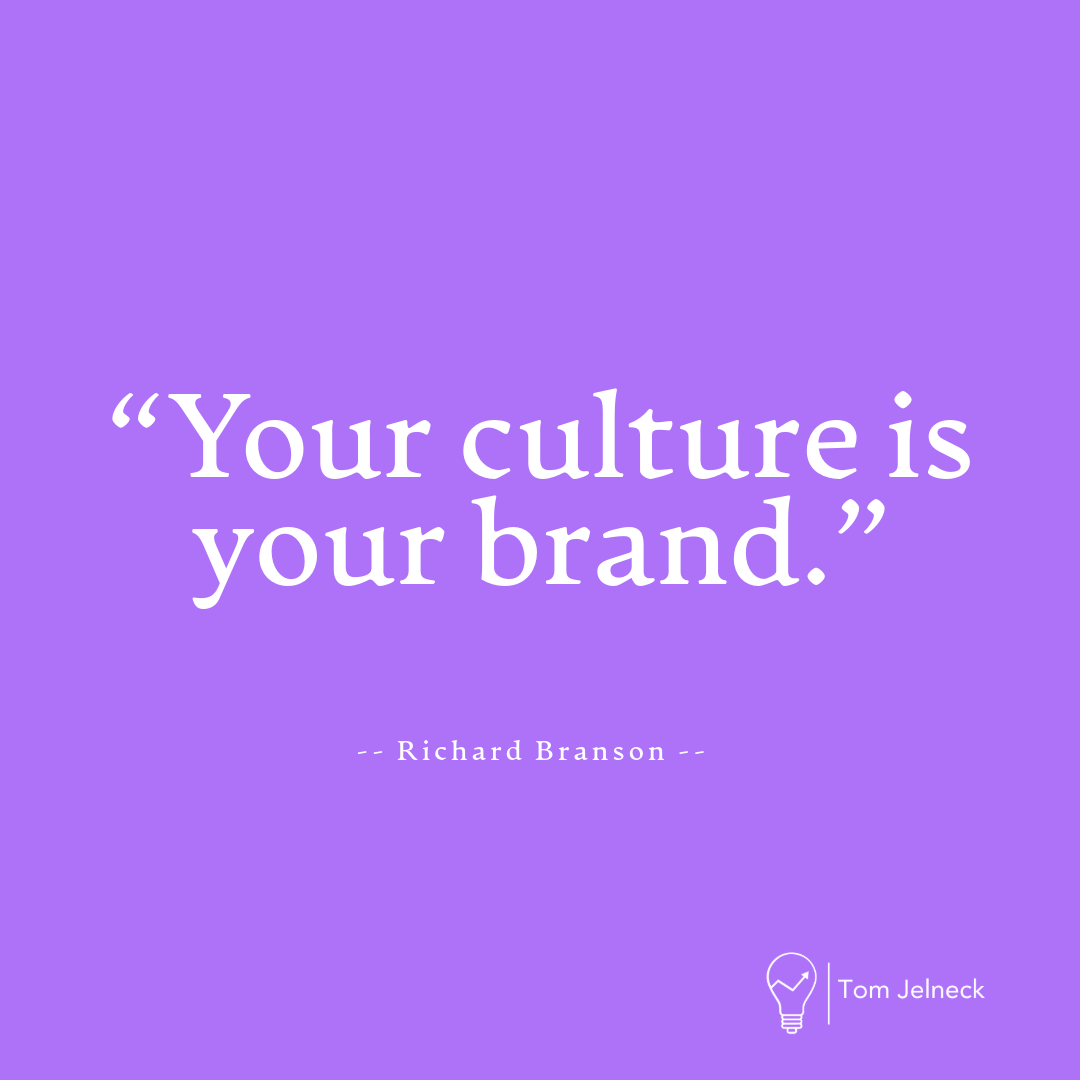
The Multi-Million Dollar Bait-and-Switch
A while back, I was looking at a company with a stunning, high-gloss brand. Beautiful website, slick ad campaigns, and a mission statement packed with corporate gobbledygook about "empathy," "innovation," and "putting people first."
Not too long ago, I was looking at a company with a stunning, high-gloss, feel-good brand. Beautiful website, slick ad campaigns, and a mission statement packed with corporate gobbledygook about "empathy," "innovation," and "putting people first."
On paper, they looked like absolute rockstars.
Then I had the chance to peek behind the curtain. The internal reality? Total disconnect.
Teams were burnt out, leadership was operating in silos, and the actual culture contradicted every single promise made on their homepage and in their employee handbook.
Here’s the hard truth:
Today’s consumers have a finely-tuned B.S. detector.
You can spend a fortune on high-gloss branding, fancy PR agencies, and influencer campaigns, but the second your internal reality doesn't match your external messaging, chinks start showing in the brand armor.
Your brand isn't defined by what you say in a marketing meeting on Monday. It’s defined by how your leadership treats people on a random Tuesday morning behind closed doors.
How to Close the Gap:
Culture IS Your Marketing:
Your team members are your front-line brand ambassadors. If your internal culture isn't human, your external brand will eventually sound fake. You can’t broadcast empathy to the world if you aren't practicing it inside your own walls.
Pass the Humanity Test:
Ditch the lawyer-speak and corporate jargon, both in your internal memos and your public messaging. Speak like a real person. Real recognizes real.
Align the Inside with the Outside:
Define what’s at the core of your business. Why do you exist? What do you actually care about? When your internal operations align with your external promise, trust follows automagically.
The Bottom Line:
Stop trying to market a brand identity you haven't actually built internally. Be real. Be genuine. When the inside matches the outside, you don't have to force authenticity, it just happens.
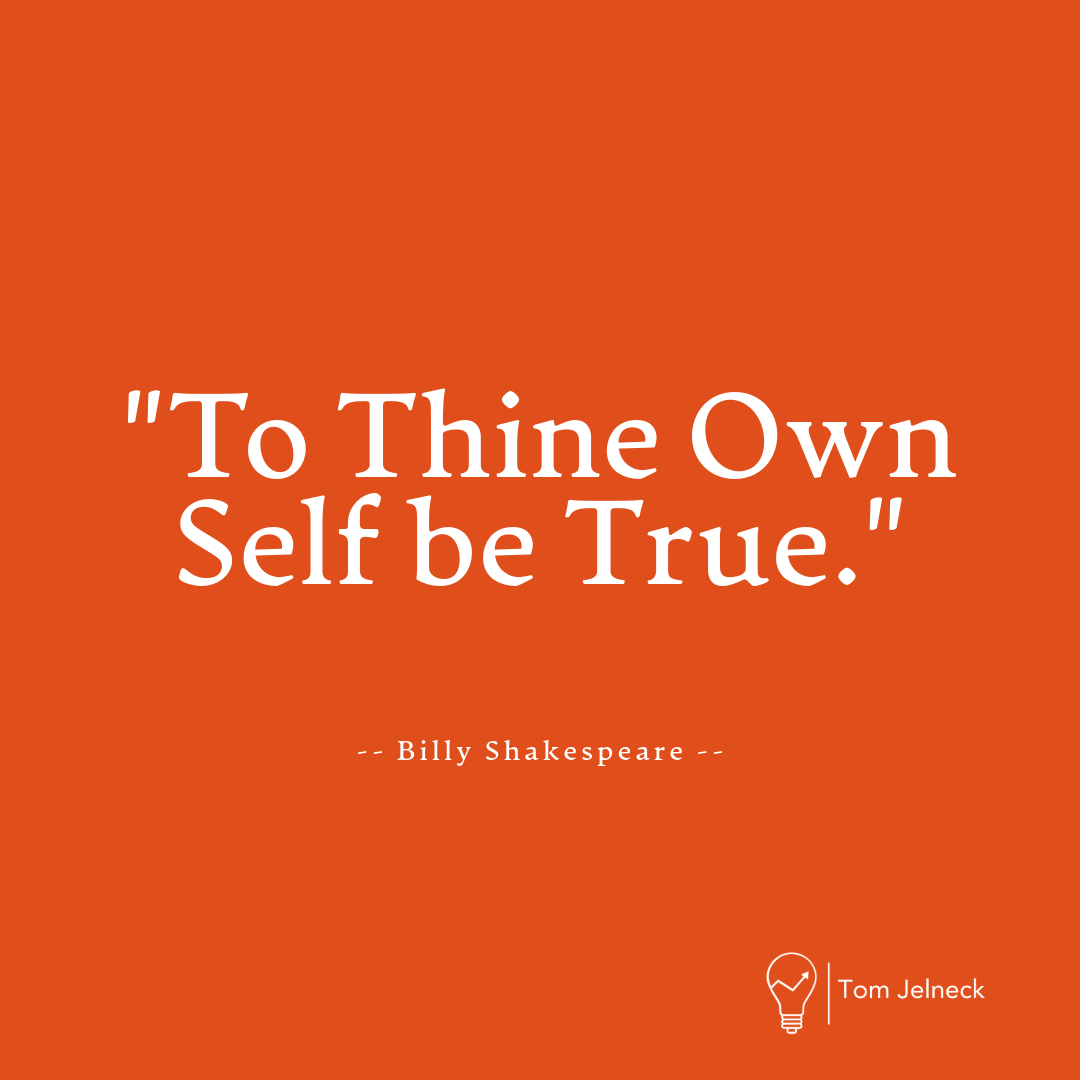
To Thine Own Self be True
Many moons ago, I was visiting a classmate's dorm at Saint Meinrad Seminary and School of Theology and he had this quote attached to his wall:
"To Thine Own Self be True."
Many moons ago, I was visiting a classmate's dorm at Saint Meinrad Seminary and School of Theology and he had this quote attached to his wall:
"To Thine Own Self be True."
I remember how much it struck me then, during a time of deep self-discovery, learning, and discernment. That quote has stuck with me throughout my life, and right through every step of my professional career.
It’s easy in the corporate/business world to lose sight of who you are and what you actually bring to the table. We get so caught up trying to fit into a pre-made mold that we forget the unique value we were brought in to deliver in the first place.
Here’s what I’ve learned over the years about knowing your worth:
▪Own your seat at the table. You weren't hired by accident. Recognize the distinct skills, perspective, and problem-solving you bring to your organization every single day.
▪ Confidence beats conformity. Real impact doesn't come from blending in or staying quiet, it comes from having the conviction to share your true insights. If the environment doesn't allow for that, it has to be evaluated.
▪ Value starts with self-awareness. When you know your own worth, you stop looking for external validation and start focusing on making a genuine difference for your team and company.
▪ Know when to take your talent elsewhere, and know that it's okay. Being true to yourself means recognizing when an organization can no longer see, support, or serve your value. Outgrowing a space isn't a failure; taking your gifts to a team that aligns with who you are is just good business.
Being true to yourself isn't just a feel-good phrase, it’s the anchor that keeps you grounded, confident, and effective in your career.
Know your worth. Deliver your value. And never forget the unique strengths you bring to the room.

The Death of the "Click-and-Go"
For years, digital marketers have been obsessed with the "click." We built our entire empires on Click-Through Rates (CTR). We optimized every headline, every button, and every meta-description to get that one, sweet, dopamine-inducing tap.
Why Dwell Time is the Only Metric That Matters in 2026

For years, digital marketers have been obsessed with the "click." We built our entire empires on Click-Through Rates (CTR). We optimized every headline, every button, and every meta-description to get that one, sweet, dopamine-inducing tap.
But here’s the cold, hard truth for 2026: The click is becoming a secondary signal.
LinkedIn (and frankly, every other major platform) has realized that a click doesn’t actually mean someone liked or valued your content. It just means you were good at baiting them. Today, the algorithm has a new master: Dwell Time.
What is Dwell Time (and Why Should You Care)?
Dwell time is the literal amount of time a user spends actively engaging with your post. It’s the difference between someone scrolling past your "Three Tips for Success" in two seconds versus someone stopping, clicking "See More," and spending 45 seconds absorbing your perspective.
In the eyes of the 2026 algorithm, Time = Trust.
If you’re a "One-Trick Marketing Pony" still trying to win with generic AI-generated fluff, you’re in trouble. Why? Because AI fluff is boring. It’s "gobbledygook." It’s a digital lens so dirty that no light can penetrate it. And because it’s boring, people don’t dwell on it. They bounce.
The Strategy: How to Build a "Magnetic" Presence
To stop the scroll and keep the "dwell," you have to stop being an echo and start being a voice. Here’s how to pivot your strategy:
1. The "See More" Engineering
Your first three lines on LinkedIn are your most valuable real estate. If you don't give them a reason to click "See More" within the first 150 characters, they never will. Avoid the "I'm so excited to announce..." trap. Start with a problem, a contrarian take, or a raw truth. Give them a reason to pause.
2. Format Diversity (The "Document" Advantage)
Data from early 2026 shows that Document Posts (Carousels) generate 3x higher engagement than static images. Why? Because every swipe right counts as an active engagement signal. It physically keeps the user on your "property" longer. If you have a complex idea, don't write a wall of text—break it into 8 slides of high-value insights.
3. The "Golden Hour" of Conversation
Dwell time isn't just about the initial read; it's about the conversation that follows. The algorithm now prioritizes "meaningful comments" (18 words or more). If you post and ghost, you’re killing your reach. You need to be in the trenches for the first 60 minutes, asking follow-up questions that force others to spend more time on your post.
The Bottom Line: Be the Hero, Not the Noise
The marketing space is fluid. Lenses that worked two years ago are archaic today. If you want to stand out from the crowd, you have to realize that the "digital stimulus" has changed. People are starving for authenticity and connection.
Stop worrying about how many people saw your post. Start worrying about how many people sat with it.
In a world of 5-second attention spans, the person who can hold someone's attention for a full minute is the one who wins the lead, the contract, and the trust.

Fixing The Glitch
If your brand is super duper excited to get to work with a new agency on that razzle-dazzle #marketingcampaign, it's always a really good idea to hit the pause button and take a deep look at the inside reality of your company.
If your brand is super duper excited to get to work with a new agency on that razzle-dazzle #marketingcampaign, it's always a really good idea to hit the pause button and take a deep look at the inside reality of your company. Does it match the persona that's about to be unleashed to the public? Is the #culture that you think you have really the culture that you do have? Is your team happy and well adjusted? Will they actually do all of the things that you're telling the world that your company will deliver? No matter how shiny and pretty the new campaign is, if your internal reality can't deliver on the promise, OR if your target consumers smell any bullshit, your brand can be screwed.
How to fix the glitch(es):
If you have any toxicity in the organization, it's time to cut it out, like, now.
Communicate with your team members with as much #transparency as humanly possible.
Some organizations will actually hire a secret shopper, I'd rather you trust in your team members enough to deliver the goods. If you have any doubts, set them free.
Build a safe and open door policy to address any real team member concerns, and here's the trick, act on their concerns and be their best advocate.
Ask your customers about their experience, not just a survey, a real conversation, and LISTEN.
Ensure that you have #customerservice protocols and procedures in place to handle customer service challenges like human beings, and not like robots.
I can't emphasize enough how important it is to get your organization shored up before you pull the #marketing trigger. It may not be easy and you may find yourself having to make some really difficult decisions for the good of the brand, but it must be done. Thanks for reading and sharing.

Hard Pass.
This ridiculously simple quote would save so many small businesses so much time, aggravation, and money if they just digested it and took it to heart. As a small business owner, sometimes the tendency is to get that product or service in front of EVERYONE.

“Everyone is NOT your customer.”
This ridiculously simple quote would save so many small businesses so much time, aggravation, and money if they just digested it and took it to heart. As a small business owner, sometimes the tendency is to get that product or service in front of EVERYONE. And while I completely understand that in terms of exposure, etc., it's almost NEVER a good idea to focus on this strategy.
I learned so many lessons owning and operating a digital marketing agency, especially in the early days. I would take ANY customer just to pay the bills, and over time, thank GOD, I came to realize that this strategy was a runway to nowhere. I had to learn how to say no and how to pass on all of the little guys who simply didn't have budget, OR didn't "get it", or simply wanted instant results.
By chiseling away until you find your target customer sweet spot, you start to also find the real value that your company brings to the marketplace. You start to stand firm on your pricing, you start to design your material for that certain demographic, you start to grow and thrive within a niche, you start to truly speak the language of the customers that are going to gravitate to you. You now KNOW your customer, and that is by far one of the fundamentals of marketing and branding.
It's not easy to pass on a customer, especially when people rely on you for paychecks, but the headaches, trouble, and the money that it costs in the long run far outweighs the quick benefit of some cash. Remember, niches make riches.
Thanks for reading, sharing, and Hard Passing on customers who don't spark joy.

Your Authentic Brand Self
With a barrage of constantly churned out content splattering all over the interwebs on the daily, it's becoming more and more challenging to garner attention for brands.
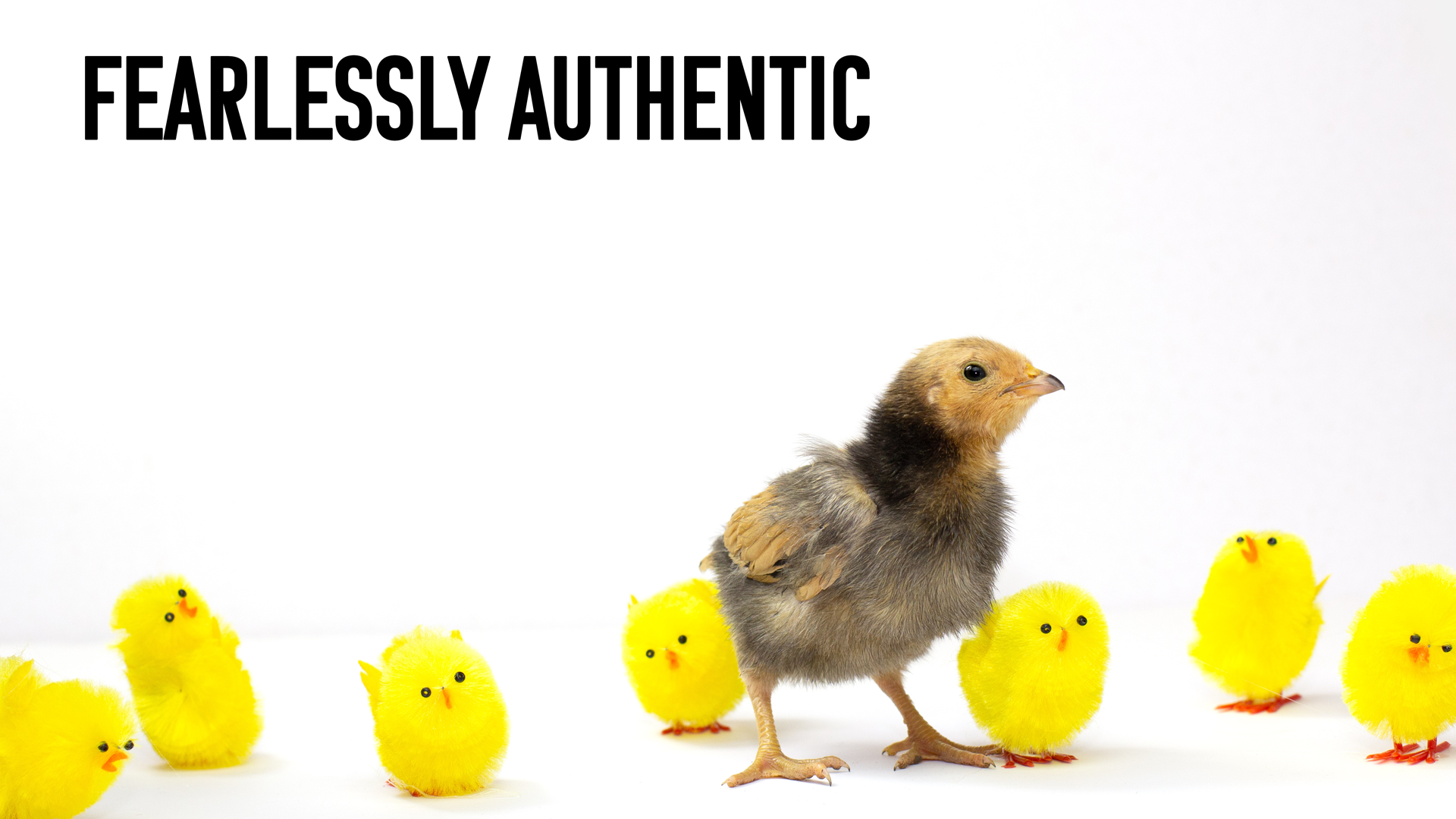
With a barrage of constantly churned out content splattering all over the interwebs on the daily, it's becoming more and more challenging to garner attention for brands. Today's consumers are hit at all angles with slick marketing messages, content being created by influencers, and ads. It's become so much that our brains can't process all of the content being thrown at us so we start to ignore the nonsense automagically.
The Humanity of it All
Some brands have a tendency to speak their own language. They do this because its the path of least resistance, it's easy. They craft messaging points about their bundles, or their products that are riddled with engineer speak or worse yet, lawyer speak. This is the stuff that becomes noise, this is the stuff that today's consumers will simply ignore.
Heroes Of The Day
The brands that are breaking through are the brands that make their consumers/prospects the hero of the message. They don't obsess about the details of their products in their messaging, rather, they focus on the impact of their goods on the target consumer. The end result, the brand triggers an emotion in the prospect, that emotion leads to a stronger connection, that stronger connection could lead to a sale, or at least, be top of mind for the consumer when they are ready to buy.
A Fine Line
How can your brand be more authentic? It starts with defining what's at the core of the business. What drives the business, why does the business exist, what does the brand care about? Articulating this "stuff" into the brand's messaging, social media content, ads, and most importantly, internally, is mission critical. Ensure that your internal messaging and reality matches your external messaging and reality, this is often the trap where consumers start to see chinks in the brand armor.
It's also critical to know your customer. What fuels them, what will make their life easier, how can we save them time, money, and aggravation? Weaving that knowledge into our brand footprint allows us to always put the customer first and ensure that any messaging point puts them first.
The Feel Good
When your prospects feel good about your messaging, or an ad brings a smile to their face, you win. You many not win this second, but you are changing something within them. That's what true marketing is, changing the way that someone feels about something. That's what we're after in all of our messaging and in all of our interactions. The brands that ask themselves, "self, how can I spark joy today" already set themselves up for success.
The Bottom Line
Be human, be sincere, be genuine and always put your customers first in all of your messaging. Striving to be different for the sake of being different will almost always result in tripping consumer bullshit detectors. Thanks for reading and sharing!

How To Be On-Brand
"Let's make sure that every social media post that we put out has our logo on it, so it's on brand." - One of my previous clients

"Let's make sure that every social media post that we put out has our logo on it, so it's on brand." - One of my previous clients
This still makes me cringe. I'd always have to explain that the brand's logo is already in about 4 other places already on the social media channel itself. But, my frustration with the above request goes way deeper than that. Branding is NOT just about your logo. Throwing that bad boy all over the interwebs isn't going to endear anyone to your "brand".
Branding is about a relationship. A relationship between the world and your company. It's about feelings, it's about humanity, it's about emotions and how your organization makes others feel when they interact with it. Branding is about building trust, and that trust is earned by being authentic. Many companies are trying to be "someone" they aren't, consumers see right through that BS.
Sure, using the same marks, the same color scheme, and the same fonts all help to eventually build some recognition, but what really helps a company connect is its ability to connect with consumers through a human voice. Corporate gobbledygook nonsense speak has never caused a consumer to fall in love with a brand, never caused them to talk about that brand, and never caused them to stay loyal to that brand.
So, how can you start to earn and build trust? Look at your words. The words on your website, your social media channels, your ads, and your other touch points need to be HUMAN. The personality of your brand should shine through each and every touch point, it should evoke an emotion, whether its fun, loving, joy-filled, or snarky, it should always stay on-voice. One of my pro-tips is to always make your target consumer the hero of your story and content. One last tip: never start a piece of content with the word WE. Put your consumer first, talk to them like a human, be consistent, and feed them what they are hungry for.

Content Marketing & Non-Profits : Tell Your Story, Tell Your Outcomes.
Attention all non-profit organizations! Have you ever considered the power of content marketing in achieving your mission and goals? Content marketing is a highly effective strategy for reaching and engaging with your target audience, and it can make a significant impact on your organization's success.
Attention all non-profit organizations! Have you ever considered the power of content marketing in achieving your mission and goals? Content marketing is a highly effective strategy for reaching and engaging with your target audience, and it can make a significant impact on your organization's success.
By creating valuable and informative content, such as blog posts, social media updates, and videos, you can establish your organization as a thought leader in your industry and build trust with your audience. This trust can then translate into increased support, donations, and volunteerism.

Content marketing also allows non-profits to tell their stories in a compelling way, showcasing the impact they have on their communities and the world. This storytelling approach can help build emotional connections with supporters and help them understand the importance of your work.
Furthermore, content marketing can be a cost-effective way to reach a large audience. With social media and email marketing, non-profits can distribute their content to a wide range of people without the need for expensive advertising.
So, if you're looking for a powerful way to increase awareness and support for your non-profit organization, consider incorporating content marketing into your strategy. With its ability to build trust, tell your story, and reach a broad audience, content marketing can be a game-changer for non-profits. #nonprofitmarketing #contentmarketing #socialimpact

One Trick Marketing Ponies.
We all have a lens that we look at things through. Things like philosophies, convictions, religion, politics, ethics, etc. and that’s what makes the well-rounded world go ’round. It’s the hodge-podge of thought, the situations that have brought us to how we think and see the sun that help shape the world.

“Your assumptions are your windows on the world. Scrub them off every once in a while, or the light won’t come in.”
We all have a lens that we look at things through. Things like philosophies, convictions, religion, politics, ethics, etc. and that’s what makes the well-rounded world go ’round. It’s the hodge-podge of thought, the situations that have brought us to how we think and see the sun that help shape the world. Sometimes, though, we get tunnel vision. One thing, and one thing only is, in our world, the only way. The only path to whatever, the only way to think, the only way others should think and when those ‘others’ don’t see it our way, they are obviously wrong. Dangerous for certain.
When it comes to digital marketing, one-sided thinking will lead to failure, maybe not today, maybe not tomorrow, but without a doubt, soon. Dirty lenses or lenses that aren’t even capable of being cleaned to let the ‘light come in’ turn into archaic thinking, and ultimately, lead to a catastrophic failure. It’s ok to have theories, it’s ok to have philosophies, but in the marketing world, there are many ways to skin the proverbial cat and honestly, the best way to skin the cat is through utilizing a wide variety of methods, a holistic approach if you will.

Meet The One Trick Marketing Pony
The one trick digital marketing pony knew about one way to do things, fifteen glorious years ago. Back in the day, this worked or back in the day, our marketing team scored hits because we simply focused on one angle. Guess what? the Internet changes EVERY day. The methods, what works, what doesn’t work. The algorithms, the attention span of a hungry digital populous, the platforms that we as a society use to post cat photos and spread proud dad photos of our kiddos. Marketing folks who rely on the way we used to do it are destined to fail. Marketers who cannot clean their marketing lenses end up in a brand tail-spin and look for the next people to blame for its failure.
The one trick digital marketing pony can’t continue to grow. The digital marketing space is fluid, as fluid as can be and certain lenses just don’t work anymore, and will probably not work again in the future. As long as we as a society keep changing the way we pay attention to stimulus and outside influences, the marketing folks worth their salt will continue to adjust strategy on the fly. They remain committed to learning, they remain OPEN to new ideas and concepts. They try, they fail, they try again and win. They rely on multiple strategies in order to skin the cat properly and cover all of the bases. They simply continue to clean their lenses.

Thanks for reading, and for cleaning your lenses from time to time.
Take care and thanks for sharing.
@TomJelneck